


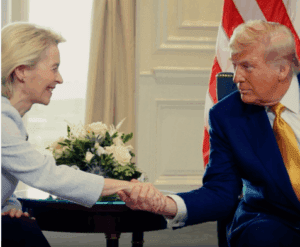
Yesterday, U.S. President Donald Trump and European Commission President Ursula von der Leyen announced a trade agreement between the United States and the European Union. The agreement introduces a standardized 15% tariff on most EU exports to the U.S., includes specific sectoral exemptions, and outlines a commitment by the EU to invest in U.S.-based industrial projects. The arrangement also creates a bilateral council for continued trade coordination and regulatory dialogue.
Agreement Components
Tariff Structure
A 15% flat tariff will apply to the majority of goods exported from the EU to the U.S. This replaces various product-specific tariffs and consolidates them into a single, uniform rate. The change does not affect U.S. tariffs on goods that fall under existing exemptions.
Sectoral Exemptions
The following sectors are excluded from the 15% tariff:
- Pharmaceuticals
- Medical equipment
- Civilian aircraft components
- Energy exports (e.g., liquefied natural gas, nuclear materials)
These exemptions are based on strategic considerations and existing supply chain interdependencies.
Tariff Freeze
The agreement includes a mutual commitment not to introduce additional tariffs while discussions continue. It does not eliminate or revise pre-existing tariffs outside the exempt categories.
Investment Commitment
The European Union has pledged $30 billion in investment over the next 18 months in specific U.S. sectors, including:
- Clean energy
- Semiconductors
- Advanced manufacturing technologies
Details regarding project implementation, oversight, and enforcement mechanisms were not included in the initial announcement.
Oversight and Ongoing Dialogue
A new Transatlantic Trade Council will be established to:
- Monitor the agreement’s implementation
- Support discussions on regulatory alignment (including digital services, AI, and data governance)
- Facilitate investment tracking and bilateral coordination
- Convene quarterly meetings between U.S. and EU officials
The council will operate in an advisory capacity. The agreement itself is not legally binding and does not require ratification by the U.S. Congress or European Parliament.
Reactions and Analysis
United States:
- Agricultural groups viewed the tariff freeze as reducing planning uncertainty for exports.
- Manufacturing associations expressed a preference for additional sector-specific exemptions but supported the predictability of the uniform rate.
- No legislative changes are required for U.S. implementation at this stage.
European Union:
- Several industry representatives, particularly in automotive manufacturing, raised concerns about the potential cost impact of the flat tariff.
- Some European policymakers have requested further detail on the regulatory and economic implications of the agreement.
- No immediate legal action is anticipated within the EU framework, though further review is likely.
Context and Outlook
The agreement reflects an effort by both parties to reduce near-term trade uncertainty and provide a structure for future dialogue. The investment pledge and tariff standardization occur in the context of broader trade realignments focused on technology, security, and supply chain resilience.
The deal does not resolve long-standing differences on digital regulation, industrial subsidies, or climate-related trade measures. Its impact will depend on how the Transatlantic Trade Council is staffed and whether the investment commitments materialize in the timeframe specified.
Summary
The July 2025 U.S.–EU agreement includes the following:
- A 15% flat tariff on most EU exports to the U.S.
- Exemptions for specific sectors
- A pause on additional tariff measures
- A $30 billion EU investment pledge in selected U.S. industries
- Formation of a trade council to oversee implementation and guide future discussions
This agreement introduces a framework for engagement between the U.S. and EU but does not contain binding legal mechanisms or eliminate existing trade barriers beyond the exempted categories.