

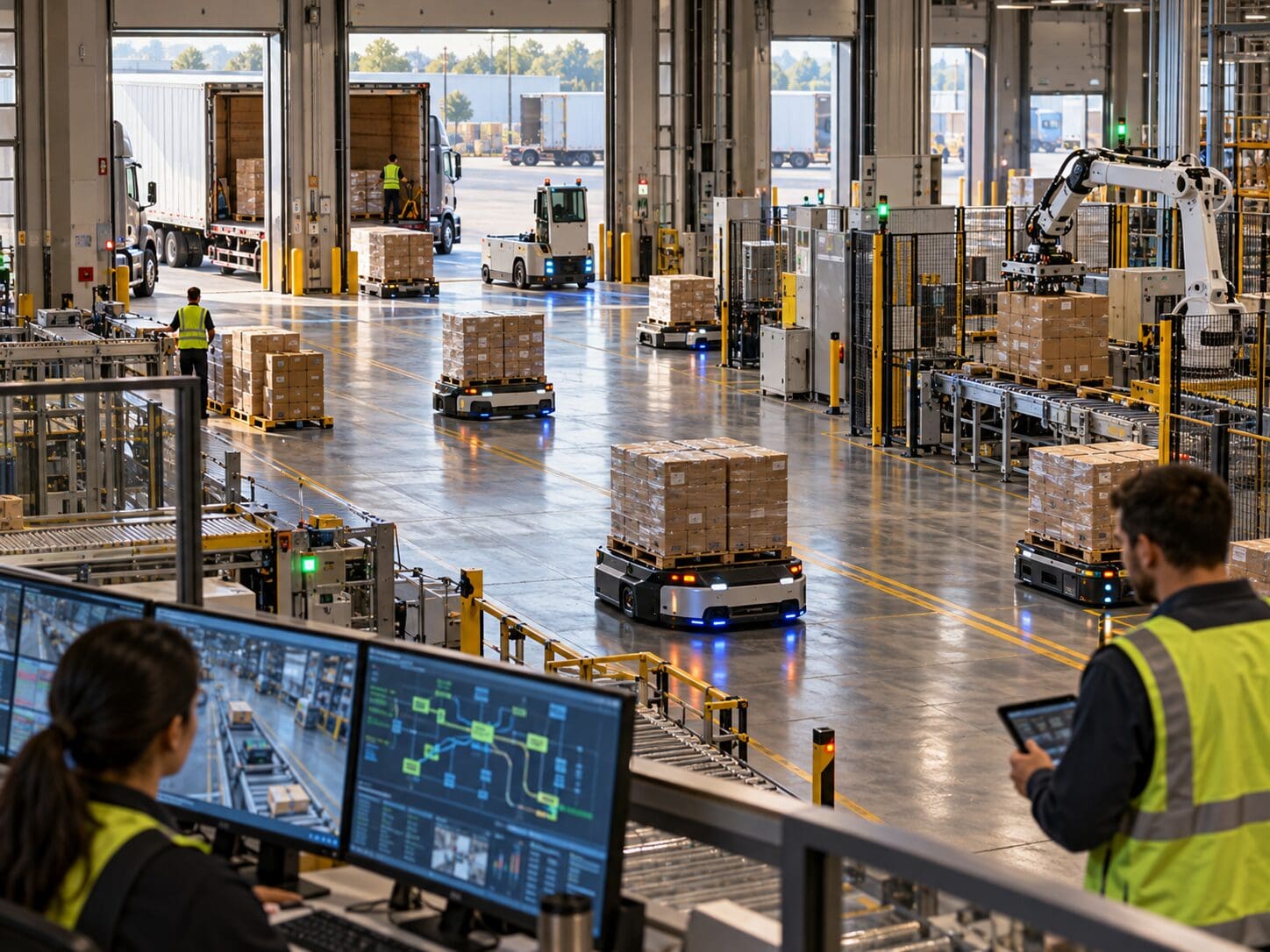
The autonomous logistics network will not arrive as a warehouse with no people or a fleet with no drivers. It will not be switched on one morning after a company installs an AI platform.
It will emerge incrementally as more routine logistics decisions stop waiting for human coordination. The path toward autonomy therefore depends on the discipline described in Engineer AI Into the Decision: authority, context, optimization, and control have to be designed together.
That is the logical conclusion of the architecture explored throughout this series. Physical assets become more observable. Execution systems become more connected. Visibility moves toward interpretation. Orchestration coordinates decisions across domains. AI handles increasingly complex information. Agents perform bounded work. Automation executes more physical tasks.
Autonomy is not a destination. It is a spectrum of delegated operational authority.
The Physical Layer
Everything begins with the physical network: trucks, trailers, containers, warehouses, docks, robots, conveyors, roads, ports, and people. These assets create the hard constraints of logistics. Capacity, distance, time, labor, infrastructure, and physics remain real regardless of how sophisticated the software becomes.
The autonomous network therefore does not replace the physical layer. It uses information and decision-making to employ that layer more effectively.
The Execution Layer
TMS, WMS, YMS, OMS, warehouse execution and control systems, and global trade applications remain the mechanisms through which much of logistics work is planned and executed. The autonomous architecture does not require one system to replace them all.
It requires those systems to expose enough state and enough controlled action for decisions to move across boundaries. A transportation event must be able to influence warehouse execution. A warehouse constraint must be able to influence transportation. A trade event must be able to influence order and inventory decisions.
The Observation Layer
Connected vehicles, sensors, telematics, RFID, computer vision, equipment data, carrier feeds, and enterprise events create a continuously changing digital picture of the operation.
This layer answers the first question of autonomy: What is happening?
Its weakness is uncertainty. Data can be incomplete, delayed, or wrong. Autonomous systems therefore need not only observations but confidence in those observations.
The Intelligence Layer
Optimization, analytics, simulation, digital twins, machine learning, and generative AI interpret the operating state.
This layer asks: What does the current state mean, what is likely to happen next, and what alternatives are feasible?
AI expands the amount of context that software can process, particularly when decisions require information from documents, messages, policies, and multiple enterprise systems rather than a single structured database.
The Decision and Orchestration Layer
This is where autonomy becomes operational. The system must determine what decision is required, which objective matters, what constraints apply, who or what has authority, and where the action should be executed. Some decisions can be automatic. Some can be prepared by software and approved by a person. Some should remain entirely human.
The sophistication of the autonomous network is not measured by how many humans it removes. It is measured by how intelligently it allocates authority.
Autonomy Is a Spectrum
A useful way to think about logistics autonomy is in levels. At one end, software observes and informs. Next, it recommends. Then it prepares actions for approval. After that, it can execute bounded decisions automatically. At higher levels, multiple systems or agents can coordinate a sequence of actions with human supervision focused on exceptions and policy.
Different logistics decisions will sit at different points on this spectrum. A routine appointment adjustment may become highly automated. A major customer-service trade-off may remain human. A warehouse robot can navigate autonomously while a facility redesign remains a strategic decision. There is no reason every decision should reach the same level of autonomy.
Humans Move Toward Governance and Ambiguity
As routine coordination becomes automated, human work changes. People remain essential where objectives conflict, relationships matter, information is uncertain, consequences are high, or the situation falls outside established policy. They also design the system itself: objectives, constraints, escalation rules, decision rights, performance measures, and acceptable risk. The human role moves from being inside every transaction toward governing the operating model and handling the exceptions machines are not authorized or able to resolve.
The economic case is broader than labor reduction. Selective autonomy can reduce decision latency, increase planner capacity, improve asset utilization, shorten exception queues, stabilize service, and allow operations to respond continuously rather than only when people are available.
It can also create new risks. Automated decisions can propagate mistakes faster. Connected systems increase cyber exposure. Poor data can create confident but wrong actions. Local optimization can become automated local optimization. That is why governance, auditability, and architecture matter as much as model capability.
The Architecture Comes Back Together
Across this series, the individual technologies have been less important than the relationships between them.
Transportation and warehousing are converging as an execution problem. A logistics control layer is emerging between events and action. Warehouses are becoming orchestrated machines. Transportation is becoming computational. Visibility is moving from tracking toward intervention. AI agents are beginning to perform bounded logistics work. Physical assets are becoming machine-readable. Decision velocity is becoming a form of capacity.
Together, these changes describe a new logistics architecture. It is not a single product category. It is an operating model in which the physical and digital systems of logistics are increasingly connected through continuous state, intelligence, decision rights, and execution.
The New Basis of Logistics Advantage
For decades, logistics advantage has depended on network design, carrier relationships, facility location, process discipline, labor, scale, and execution excellence. Those factors will remain important. But another dimension is being added.
Two companies may have similar warehouses, similar transportation capacity, and access to similar technology. The better-performing network may be the one that recognizes change sooner, understands consequences more accurately, decides with less friction, and executes before the intervention window closes. That is the emerging competitive loop:
sense -> understand -> decide -> execute -> learn. The autonomous logistics network is ultimately not about removing people from logistics. It is about removing unnecessary latency from logistics.
The organizations that do that well will not simply have more automation. They will have a logistics system capable of turning information into coordinated physical action at a speed and scale that traditional functional management could not achieve. That is the new architecture of logistics.
Across the series, the individual technologies matter less than the relationships between them. Transportation and warehousing converge as an execution problem. A control layer emerges between events and action. Warehouses become orchestrated cyber-physical systems. Transportation becomes continuously computational. Visibility moves from tracking toward intervention. AI agents begin to perform bounded work. Physical assets become increasingly machine-readable. Decision velocity becomes a multiplier on physical capacity.
Together, these changes describe a logistics operating model built around continuous state, intelligence, decision rights, orchestration, and execution. The objective is not autonomy for its own sake. It is the disciplined removal of unnecessary latency from logistics while preserving human judgment where consequences, ambiguity, relationships, or policy require it.
Logistics Viewpoints examines the technologies, operating models, and market developments shaping transportation, warehousing, fulfillment, automation, and logistics execution. This client edition consolidates the complete New Architecture of Logistics series into a single executive document.
Related Logistics Viewpoints research
- The New Architecture of Logistics
- Systems Engineering in Logistics
- 2026 Supply Chain Decision Intelligence Market Map
- Amazon Launches "Supply Chain Services" Leveraging its Global Logistics Network
- Previous in this series: The Decision Bottleneck Is Becoming a Logistics Capacity Constraint
Request The New Architecture of Logistics Client Edition
If your organization is assessing connected execution, orchestration, AI, observability, decision velocity, or selective autonomy, I would be glad to provide the complete client edition and discuss the implications for your logistics operating model and technology architecture.
FREE ARC WEBINAR • OCTOBER 29 • 11:00 AM ET
Five Markets Are Converging. Who Owns the Decision?
ARC will put WMS, TMS, Supply Chain Planning,
Decision Intelligence, and Autonomous Exception Management
on one architectural canvas. See where the boundaries are
moving — and what technology buyers should do about it.
FIVE ARC MARKETMAPS • 45 MINUTES • FREE
October 29 • 11:00 AM ET
Featured Logistics Research
|
Executive Research |
2026 MarketMaps |
Explore |
Independent ARC Advisory Group research and Logistics Viewpoints analysis.