


Supply chain technology markets are becoming harder to evaluate.
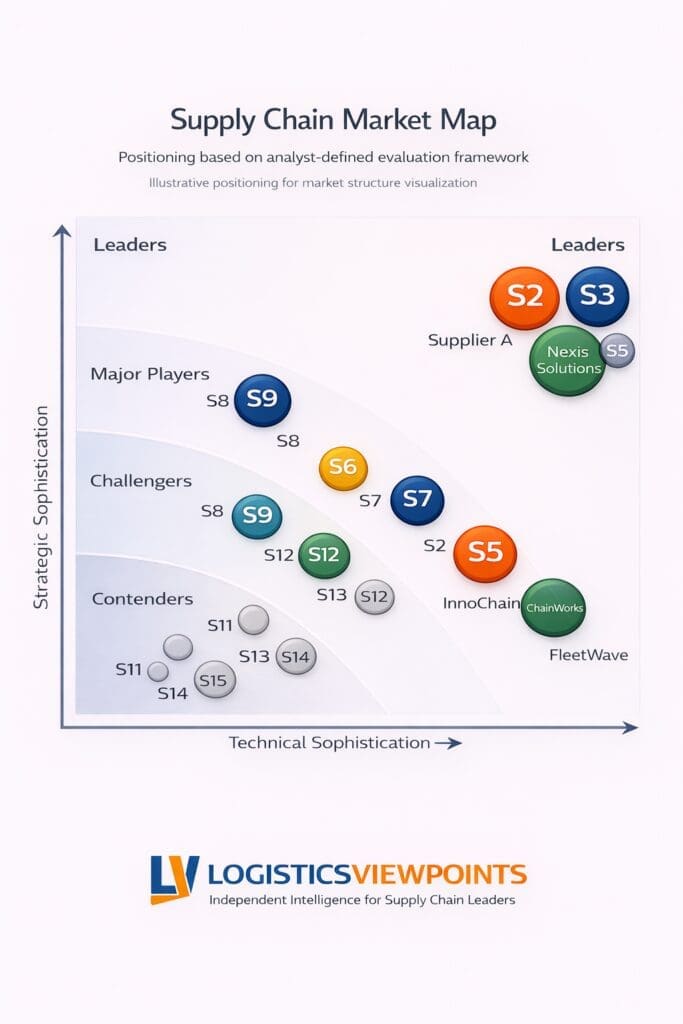
Categories are blurring. WMS, WES, robotics, visibility, AI, planning, and multi-enterprise platforms increasingly overlap. Providers often describe similar capabilities in different language. Buyers are left sorting through noise.
That is why market structure matters.
Download the Supply Chain Market Maps datasheet to learn more.
Logistics Viewpoints Market Maps are designed to clarify supply chain technology categories, organize the provider landscape, and apply a consistent analyst-defined framework for evaluation.
For buyers, Market Maps support category education, provider shortlisting, and internal alignment before selection. For suppliers, they provide a clearer external view of positioning, differentiation, and go-to-market fit.
Each Market Map includes a defined market scope, analytical positioning model, visual provider landscape, curated provider set, evaluation framework, and supporting analysis.
Market Maps are being developed across key supply chain technology categories, including WMS, AI in the Supply Chain, Supply Chain Context Intelligence, Autonomous Trucking, Omnichannel, Multi-Enterprise Supply Chain, AMRs, and Robotic Picking Systems.
Supply chain technology decisions are too important to be shaped only by vendor claims. They need structure, context, and disciplined comparison.
Download the Supply Chain Market Maps datasheet to learn more.
Research & Analysis
A practical framework for A2A coordination, MCP, and graph-enhanced reasoning in modern supply chain systems.
AI is moving beyond isolated copilots and into coordinated, operational decision systems. This ARC Advisory Group white paper explains how A2A, MCP, retrieval architectures, and graph-enhanced reasoning are beginning to reshape supply chain execution, visibility, and resilience.
Free download • 10-minute read
Independent ARC research for supply chain leaders and technology decision-makers.