

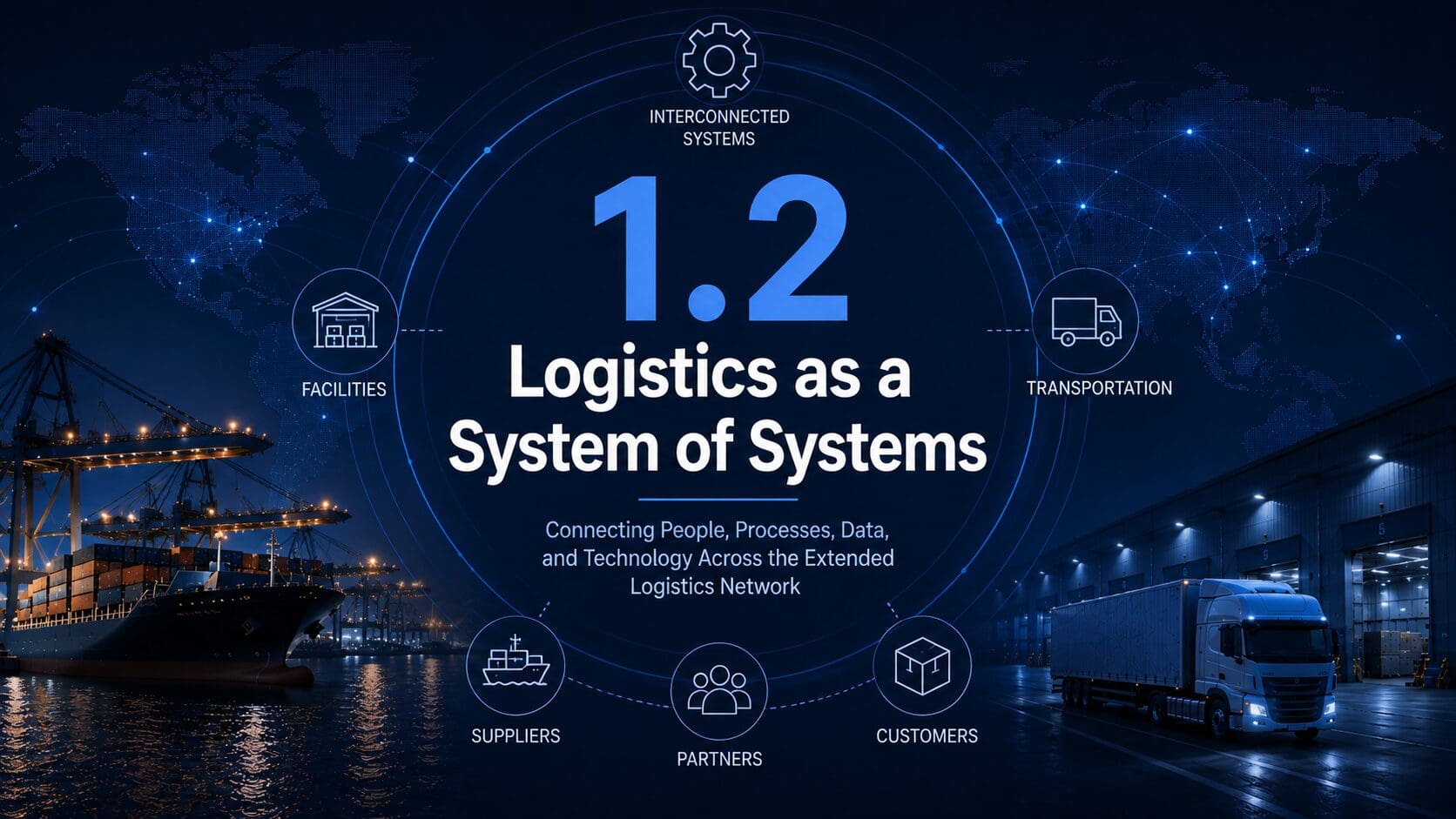
Calling logistics a network is accurate, but it is not sufficient. A network describes connections; it does not explain how independently managed transportation, warehousing, fulfillment, yard and dock operations, last-mile delivery, technology, partners, and people combine to produce one customer outcome. The more useful model is a system of systems.
The practical consequence is important. You cannot understand logistics performance by looking at any one component in isolation.
Every Function Is Rational. The System Still Can Be Wrong.
A warehouse is optimized around throughput, storage, labor, service requirements, and physical constraints. A transportation operation is optimized around modes, routes, carrier capacity, cost, service, and variability. A yard operation is optimized around appointments, dwell, doors, and trailer flow. None of those perspectives is wrong. The difficulty appears when they are connected.
None of those perspectives is wrong. The difficulty appears when they are connected.
Consider a seemingly simple promise to offer later customer order cutoffs. Commercially, it may be attractive. Operationally, it can change picking waves, labor schedules, carrier tender timing, dock congestion, linehaul departure, delivery commitments, and exception management. The decision spans multiple systems, and the value appears only if those systems can absorb the change together.
A system-of-systems view forces the organization to see that dependency before the change is made.
The Network Does Not Report to You
Traditional engineering often assumes a designer has meaningful control over the system being built. Logistics networks rarely offer that luxury.
Carriers have their own network economics. 3PLs optimize their facilities and labor. Parcel providers manage sort capacity and delivery density. Ports and terminals manage gates, berths, yards, and appointments. Customers change ordering behavior. Software providers determine product road maps. Regulatory agencies change requirements. Labor markets move independently of corporate plans.
These entities participate in the same operating system without being subordinate to a single designer. That is one of the defining characteristics of a system of systems. Its components can operate independently, evolve independently, and still affect the performance of the whole.
This helps explain why seemingly small external changes can create disproportionate logistics effects. A carrier-capacity shift can alter fulfillment strategy. A missed linehaul departure can invalidate an otherwise efficient warehouse wave. A new customer cutoff can create technology and process work across order release, picking, staging, tendering, and delivery.
Logistics is not simply complicated. It is adaptive.
Complexity Raises the Price of Weak Architecture
When systems are relatively simple, coordination can rely heavily on experience and informal processes. As complexity increases, that becomes less reliable.
Architecture provides structure.
Process architecture defines how work moves across the enterprise. Data architecture defines how information is created, governed, shared, and interpreted. Decision architecture defines who or what makes decisions, what inputs are used, how quickly decisions must be made, and when escalation is required. Technology architecture provides the applications, integration, analytics, and automation that support those processes and decisions.
These architectures overlap. They should.
The mistake is to allow one of them, usually technology architecture, to become the de facto operating model. When that happens, organizations begin designing work around system capabilities instead of designing systems around business requirements. The result may be technically integrated while remaining operationally fragmented.
Treat Every Handoff as a Design Decision
In a system of systems, interfaces are not plumbing. They are part of the product.
The interface between order management and fulfillment determines whether customer promises are executable. The interface between a shipper and a carrier determines whether capacity commitments are reliable. The interface between an optimization engine and a TMS or WMS determines whether a recommendation can actually be executed. The interface between an AI agent and a human determines whether automation accelerates decisions or simply creates another queue of suggestions.
These interfaces should have explicit requirements.
What information must cross the boundary? At what frequency? With what latency? Who owns data quality? What happens when the message is incomplete? Which decisions can be automated? What happens when two systems disagree?
Organizations frequently discover these questions during implementation. Systems engineering argues that they should be part of design.
Measure the Enterprise Outcome, Not the Local Win
A system-of-systems view also changes performance measurement.
Functional metrics remain necessary, but they are insufficient. A warehouse can hit its productivity target while order cycle time gets worse. Transportation can reduce cost per shipment while dock dwell or delivery variability increases. A parcel operation can lower rate per package while missed cutoffs rise. The larger question is whether the total logistics system is improving service, cost, flow, and responsiveness together.
The larger question is whether the total system is producing the outcomes the business requires.
That means metrics should connect across levels. Local operating measures should roll into end-to-end logistics measures such as on-time delivery, perfect-order performance, order cycle time, cost per shipment or order, dock dwell, capacity utilization, responsiveness, resilience, and decision speed. The organization needs to understand where local gains create system gains and where they simply move cost, delay, or risk somewhere else.
Change the Question, Change the Design
The system-of-systems idea may sound theoretical, but it is a useful operating model for logistics leaders. It explains why local optimization is dangerous, why interfaces matter, why technology integration alone does not create end-to-end performance, and why transformation requires architecture across organizational boundaries.
The practical shift is straightforward: stop asking whether each function is performing well in isolation and ask whether the combined system is producing the outcome the enterprise needs. In 1.3, that system view becomes operational: we move from understanding the whole to defining what the whole must actually do before technology enters the discussion.
Related Logistics Viewpoints research
- Systems Engineering in Logistics
- The New Architecture of Logistics
- 2026 Supply Chain Decision Intelligence Market Map
- Guest Commentary: Control Tower 2.0 – Managing Logistics Costs in a Risky and Volatile World
- Previous in this series: Why Logistics Needs Systems Engineering
Request the Systems Engineering in Logistics Client Edition
If your organization is evaluating a logistics transformation, technology strategy, automation program, or operating-model redesign, I would be glad to provide the complete client edition and discuss how the framework applies to your priorities, constraints, and operating environment.