


For most of its history, Logistics Viewpoints has focused on the technologies, processes, and strategies that help organizations operate more efficiently and build more resilient supply chains.
That mission remains unchanged.
What is changing is the scope of the forces reshaping supply chains and industry.
Artificial intelligence is no longer simply a software topic. It is becoming an infrastructure topic. It is influencing how organizations consume software, where computing takes place, how energy is generated, how information is monetized, and how capital markets value industrial enterprises.
For supply chain leaders, these developments matter because they will shape the systems, costs, risks, and capabilities that define future operations.
Increasingly, some of the most important developments affecting supply chains are occurring outside traditional supply chain domains.
A breakthrough in local AI models can change how intelligence is deployed across warehouses, factories, transportation networks, and field operations.
A nuclear power plant restart can influence the availability of electricity needed to support future AI infrastructure.
A new standard for AI token economics can reshape how enterprises measure, govern, and pay for AI services.
A space company can become one of the world’s most valuable AI infrastructure providers.
A new computing architecture can redefine what is possible in optimization, simulation, and decision-making.
These developments do not fit neatly into traditional categories such as transportation, warehousing, procurement, manufacturing, or planning. Yet they have direct implications for all of them.
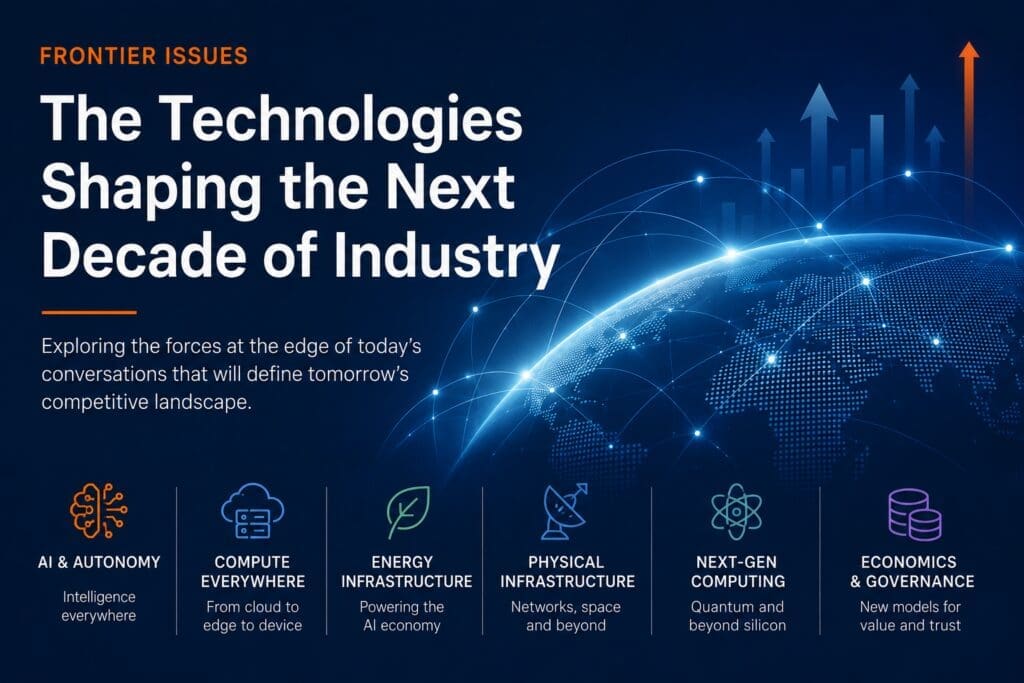
To explore these emerging themes, Logistics Viewpoints is launching Frontier Issues.
Frontier Issues will examine the technologies, infrastructure, economics, energy systems, and policy developments shaping the future of industry. The focus will not be on product announcements or short-term market noise, but on understanding the larger forces that will influence how organizations operate over the next decade.
The series is built around a simple premise: the future rarely arrives as a single breakthrough. It emerges through a series of connected developments that, taken together, reshape industries, business models, and competitive advantage.
Our initial Frontier Issues series includes:
AI Agents Don’t Replace Software — They Consume It
As AI agents become autonomous users of enterprise applications, they are changing the economics of software consumption. Rather than replacing systems such as ERP, CRM, and supply chain applications, agents may dramatically increase their utilization, creating new demands on infrastructure, integration, and governance.
Google’s Gemma 4 12B and the Rise of Local Enterprise AI
For years, AI has been associated with massive cloud data centers. New generations of smaller, more efficient models suggest that much of the future of enterprise AI may run locally on laptops, edge devices, factory systems, and operational technology environments.
Constellation’s Three Mile Island Restart Gets a Regulatory Boost
The AI economy runs on electricity. As demand for compute accelerates, organizations are reexamining the role of nuclear power, grid modernization, and long-term energy infrastructure in supporting the next wave of industrial innovation.
SpaceX’s Next Launch Is Not to Mars — It’s Into Artificial Intelligence
SpaceX is increasingly being viewed not only as a space company but also as a potential AI infrastructure company. The story reflects a broader shift in how investors value organizations that combine physical infrastructure, data assets, and intelligence platforms.
Quantum Computing: Hype or the Real Deal?
Quantum computing has generated enormous interest and equally enormous skepticism. Beyond the headlines lies a practical question for industrial organizations: where, when, and how might quantum technologies create real business value?
Linux Foundation Announces the Tokenomics Foundation
As AI systems become embedded throughout enterprises, questions of measurement, governance, consumption, and monetization become increasingly important. The emergence of open standards for AI token economics signals the development of a new economic layer for artificial intelligence.
Taken together, these articles explore different layers of the emerging AI economy:
- Consumption
- Deployment
- Energy
- Infrastructure
- Compute
- Economics
Each represents a foundational component of the systems that will shape the next generation of industrial operations.
The goal of Frontier Issues is straightforward.
We want to help supply chain, logistics, manufacturing, and technology leaders understand not only what is happening today, but what will matter tomorrow.
Because the organizations that thrive in the next decade will not simply react to change. They will recognize important signals early, understand how those signals connect, and position themselves accordingly.
That is the purpose of Frontier Issues.
To identify the developments at the edge of today’s conversations that may define tomorrow’s competitive landscape.
AI Is Reshaping Supply Chain Execution. Here’s What Comes Next.
Two ARC Advisory Group white papers on the next stage of AI in supply chain operations.
AI is moving beyond isolated copilots and technical architecture into coordinated operational decision systems. This ARC Advisory Group white paper explains how supply chain AI is shifting from capability to execution, where context, governance, workflows, thresholds, and action pathways determine whether AI improves real decisions across planning, logistics, sourcing, fulfillment, and risk management.
Download Our Featured White Paper:
AI in the Supply Chain Part II: From Architecture to Execution - Defining the Decision Intelligence Layer in Modern Supply Chain
Download Our Foundational White Paper:
AI in the Supply Chain: Architecting the Future of Logistics with A2A, MCP, and Graph-Enhanced Reasoning
Explore Our Domains
Planning, Execution & Visibility | Transportation & Logistics Operations | Warehousing, Fulfillment & Automation | Global Trade & Compliance | AI & Advanced Analytics | Data, Integration & Interoperability | Supply Chain Platforms | Risk & Resilience | Sustainability & ESG
Independent ARC research for supply chain leaders and technology decision-makers.