


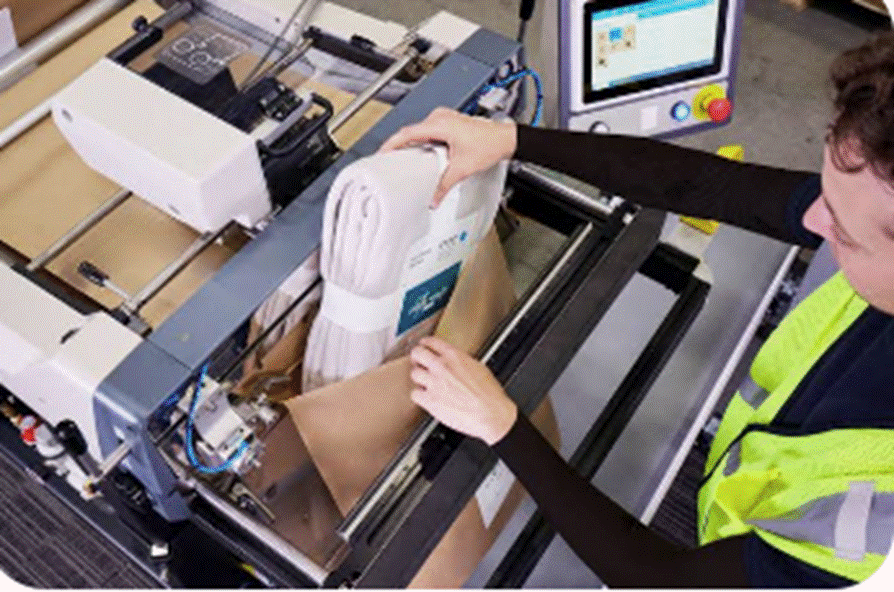
For years, automated bagging systems have been viewed primarily as inventory preparation tools. Retailers, e-commerce companies, and third-party logistics providers (3PLs) commonly use systems from suppliers such as Pregis, PAC Machinery, Autobag, and Sharp Packaging to pre-bag products before storage or fulfillment. The value proposition has traditionally centered on reducing manual packaging labor and improving consistency. However, a growing number of warehouse operators are discovering that automated bagging technology can create even greater value when positioned directly at pack-out stations.
As distribution centers continue to battle labor shortages, rising order volumes, and pressure to improve throughput, the humble auto bagger is becoming an increasingly important tool for modern packing operations.
The Labor Challenge at the Pack Station
Packing remains one of the most labor-intensive processes within warehouse operations. Associates must select packaging, insert products, seal shipments, apply labels, and move completed orders downstream. Even in highly automated fulfillment centers, much of this work remains manual. Industry investments have focused heavily on goods-to-person robotics, autonomous mobile robots, and automated storage and retrieval systems (AS/RS). Yet many organizations still find packing stations becoming operational bottlenecks.
A typical packer may spend significant time handling bags, opening packaging materials, selecting the correct size, and manually sealing orders. While each activity may only take seconds, those seconds accumulate across thousands of daily shipments. The result is reduced throughput and increased labor costs during peak periods.
Rethinking the Role of Auto Baggers
Traditional deployment models place auto baggers upstream in the operation where inventory is packaged before being stored. While this approach provides efficiency gains, it does not fully address the labor requirements associated with order fulfillment. Instead, warehouses can deploy automated bagging systems directly at pack stations.
In this workflow, items arrive at the packing location via conveyor, AMR, or goods-to-person system. The auto bagger automatically presents an appropriately sized bag, the operator inserts the item, and the system prints labels and seals the package in a single process. By eliminating manual bag handling and sealing steps, workers can focus on exception management and order verification rather than repetitive packaging tasks. The result is a streamlined process capable of supporting substantially higher throughput per operator.
A Better Fit for E-Commerce
The model is particularly compelling for e-commerce operations shipping a high percentage of soft goods, apparel, cosmetics, health products, and small consumer packaged goods. Many of these items do not require corrugated cartons. Instead, flexible packaging can reduce material consumption while also lowering transportation costs due to reduced package dimensions and weight.
For operations shipping millions of small parcels annually, even modest reductions in packaging material and parcel shipping charges can produce significant savings. Auto baggers also support more consistent package quality. Uniform package dimensions can improve downstream sortation performance and reduce carrier-related issues associated with irregular packaging.
The ROI Story
For supply chain executives evaluating automation investments, the financial argument may be even more compelling than the operational one. Consider a 3PL or e-commerce distribution center processing 8,000 parcel orders per day. If automated bagging improves packer productivity by just 20 percent, a facility operating two shifts could effectively eliminate several full-time equivalent positions while handling the same volume. Assume six positions can be redeployed from packing activities at an annual loaded labor cost of $55,000 per employee. The labor savings alone would exceed $330,000 annually.
Additional savings often come from:
- Reduced packaging material consumption
- Lower parcel shipping costs through package size optimization
- Improved throughput during peak seasons
- Reduced training requirements for temporary labor
- Better ergonomics and lower repetitive-motion risks
Under these assumptions, a facility could potentially achieve payback in less than two years depending on system configuration and throughput requirements.
A Natural Complement to Warehouse Automation
Auto baggers will not receive the same attention as robotic picking systems or AS/RS deployments. They are not as visually impressive, nor are they typically viewed as transformational technology. Yet many warehouse leaders are discovering that small process improvements often generate substantial returns. Companies such as Pregis, PAC Machinery, and other packaging automation providers have continued to expand their automation portfolios because packaging remains one of the last heavily manual activities within many fulfillment operations.
As organizations pursue end-to-end fulfillment efficiency, deploying automated bagging technology at pack stations represents an opportunity to remove labor from a critical bottleneck while improving consistency and reducing costs. In an era where warehouse operators are scrutinizing every labor hour and every package shipped, the next packaging innovation may not be found upstream in inventory preparation. Instead, it may be sitting directly at the pack station, quietly increasing throughput one bag at a time.
Bottom Line: Auto baggers are often viewed as fulfillment support tools, but their greatest value may lie at the pack station itself. By automating packaging presentation, sealing, and labeling, organizations can improve labor productivity, reduce packaging costs, and create measurable ROI without undertaking a major warehouse redesign. This makes automated bagging a practical and accessible automation investment for both e-commerce operators and 3PL providers.