

 As logistics leaders face growing pressure, from tighter delivery windows to environmental mandates, geopolitical instability, and driver shortages, one technology is proving to be a game changer: V2X (Vehicle-to-Everything) communication. It is a practical tool, actively helping fleets reduce idle time, improve safety, and gain real-time situational awareness across the supply chain.
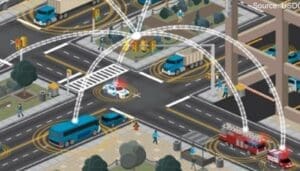
V2X allows vehicles to exchange data with their environment: other vehicles, traffic signals, the cloud, 5G networks, and pedestrians. Whether refining freight logistics efficiency at port terminals or enhancing last-mile delivery in urban neighborhoods, V2X adds intelligence to every vehicle interaction.
Here is what logistics leaders need to know about how V2X is being deployed today, and what it means for the future.
What Is V2X and Why Should Logistics Teams Care?
V2X enables vehicles to “talk” to their surroundings through real-time wireless communication. The five key modes include:
- V2V (Vehicle-to-Vehicle) – used for platooning, cooperative braking, and convoying
- V2I (Vehicle-to-Infrastructure) – interacts with traffic signals, gates, signage, and curbs
- V2P (Vehicle-to-Pedestrian) – alerts drivers to pedestrians, cyclists, or school zones
- V2N (Vehicle-to-Network) – enables dynamic routing via mobile networks and 5G
- V2C (Vehicle-to-Cloud) – integrates fleet-level intelligence, diagnostics, and analytics
For supply chain leaders, the impact is clear: reduced incident rates, enhanced delivery predictability, and smarter fuel and resource use. V2X is not simply a standalone tool, it is the connector for IoT infrastructure that drives informed decision-making.
Key Stakeholders in the V2X Ecosystem
| Stakeholder Category | Example Players | Logistics Role |
|---|---|---|
| OEMs | Volvo Trucks, Stellantis | Provide V2X-capable delivery vehicles |
| Tech Providers | Bosch, Huawei, Ericsson | Build platforms and sensors for V2X connectivity |
| Delivery Platforms | Amazon, Domino’s, Kroger | Optimize last-mile and mid-mile delivery |
| Telecom Providers | Telia, China Mobile, Verizon | Enable low-latency V2N communication |
| Smart Infrastructure | Port of Hamburg, urban DOTs | Deploy V2I networks and roadside units |
Five Real-World V2X Use Cases in Logistics
Amazon + Stellantis: Smarter EV Delivery with Cloud-Connected Vans
Amazon has partnered with Stellantis to embed V2X-capable technology into its ProMaster EV commercial fleet. The vans will use real-time road data and V2I infrastructure to avoid congestion, prioritize signals, and reduce downtime during deliveries. The system also integrates with Amazon’s cloud logistics platform to improve package drop-offs based on road and traffic conditions.
Volvo Trucks + Ericsson + Telia: V2X-Enabled Freight Convoys
In Sweden, Volvo Trucks partnered with Ericsson and Telia to show how 5G-enabled V2X supports coordinated braking and vehicle platooning. Trucks in convoys share braking and hazard data in real time, enabling safer highway operations and tighter fuel-efficient spacing. This type of cooperative driving is ideal for long-haul logistics.
Bosch + Port of Hamburg: V2X for Urban Freight Flow Optimization
At one of Europe’s busiest ports, Bosch has deployed infrastructure that connects trucks to dynamic signage, smart signals, and route suggestion engines. V2X data helps drivers avoid chokepoints, reduces idle times, and provides just-in-time arrival coordination for terminal operators. This is a working model for connected urban freight corridors.
Nuro + Domino’s: Autonomous Last-Mile Delivery with V2X
Domino’s uses Nuro’s low-speed, driverless delivery vehicles in suburban neighborhoods. These bots communicate with infrastructure (V2I) and detect people and bicycles (V2P) to ensure safety at crosswalks, intersections, and driveways. V2X enhances navigation, safety, and customer satisfaction for contactless food delivery.
Huawei + Yutong: V2X in Autonomous Logistics Shuttles
Huawei’s 5G V2X platform powers autonomous buses and is being adapted for low-speed logistics shuttles by Yutong in Zhengzhou. The system communicates with traffic lights, pedestrians, and cloud services to ensure safe route progression. This model is extendable to warehouse-to-terminal shuttles for goods movement.
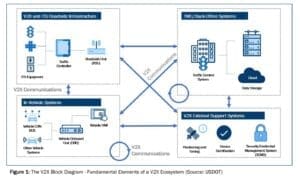
System Infrastructure
Challenges Slowing V2X Adoption
- Infrastructure Gaps – Most cities still lack smart intersections and connected signals, limiting V2I use.
- Interoperability Issues – Competing standards (DSRC vs. C-V2X) create compatibility risk for fleet owners.
- Cybersecurity & Privacy – Logistics fleets must secure vehicle, route, and customer data from interference.
- Unclear ROI for Fleets – Operators want to see short-term efficiency gains, not just long-term potential.
Strategies for Scalable V2X Deployment in Logistics
- Start with Retrofit-Friendly Fleets
Not every operator can replace their fleet overnight. Retrofit kits let companies upgrade existing assets gradually while still reaping the benefits of V2X. - Collaborate with Municipalities
Smart loading zones, curbside sensors, and priority signals require city infrastructure. Logistics firms should co-develop connected corridors with DOTs and urban planners. - Adopt Zero-Trust Cyber Practices
V2X introduces new attack surfaces. Adopt security platforms that encrypt, authenticate, and monitor every message and device in your connected fleet. - Track KPIs, Not Buzzwords
Evaluate V2X based on tangible logistics metrics: fuel savings, delivery times, accident rates, and emissions. Focus on what drives profit and safety, not just innovation.
What’s Coming in V2X Logistics
- V2X Mandates for Urban Fleets
Cities may require V2X for commercial vehicles working in zero-emission zones or around schools and hospitals. - Intermodal Hubs with Real-Time Sync
Ports and warehouses will be linked to freight networks via V2X for seamless scheduling, routing, and gate access. - Autonomous Freight Convoys
Expect mid-mile convoys of V2X-enabled autonomous trucks for coast-to-hub routes, minimizing driver load and improving fuel efficiency. - Carbon-Credited Deliveries
Regulators may reward fleets that submit verified low-emission delivery data collected via V2X as part of ESG reporting. - Shared Infrastructure Funding
Fleet operators and cities may share costs for curbside connectivity, smart intersections, and data hubs, because all benefit from the reduced congestion and improved safety.
It is Operational Infrastructure, and It is Coming Soon…
For modern logistics networks, V2X is a near-term requirement for safety, efficiency, and future-readiness. From smarter school zones to automated ports, connected fleets will outperform and outlast legacy approaches