

Investment Banks To Set Worst Run In Over A Decade
Here’s a clean UK English rewrite in the GFM Review house style (~1,000 words):
Investment Banking Set to Extend Worst Run in Over a Decade
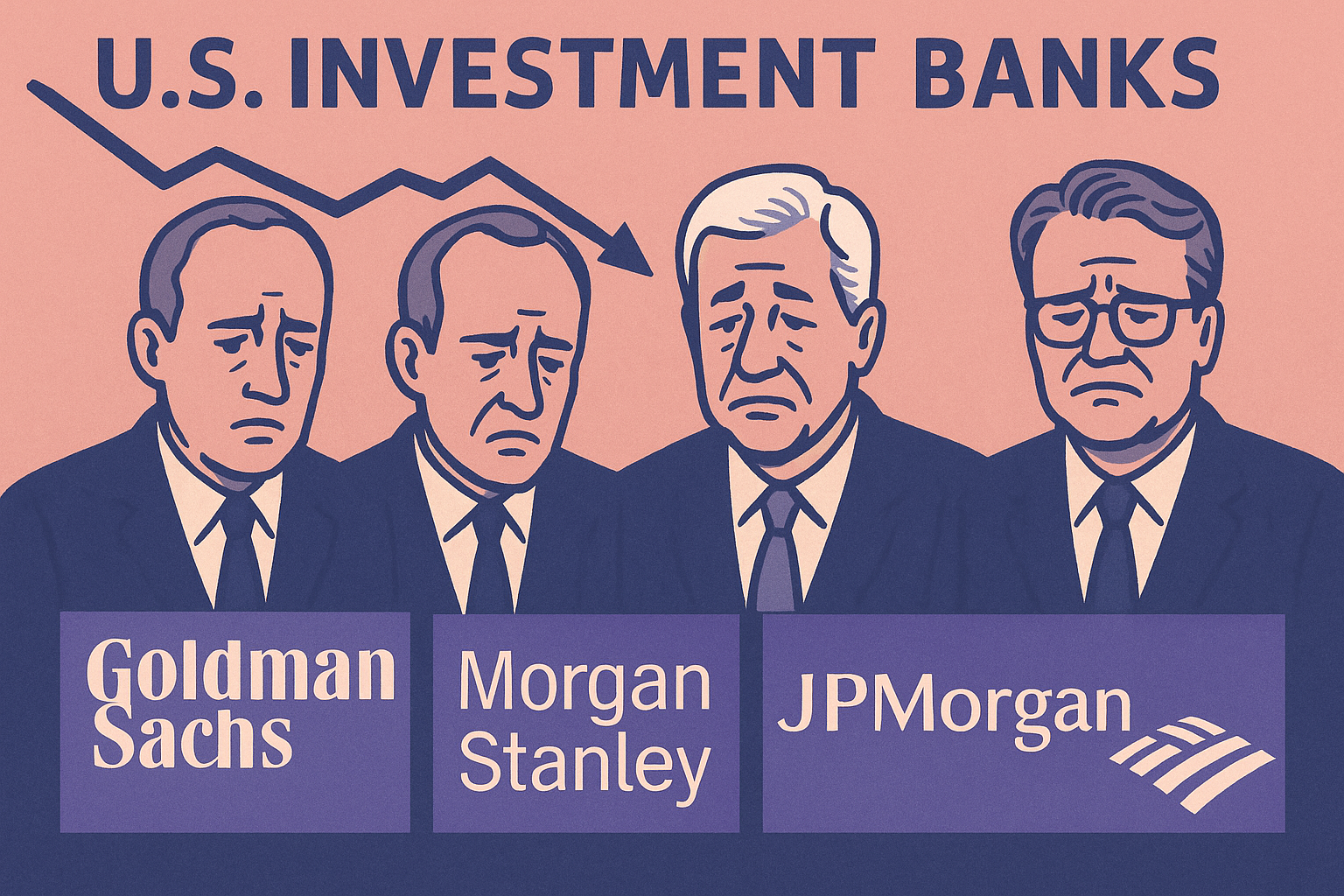
Investment banking is on track to extend its most prolonged slump in more than ten years, with the biggest US banks once again relying on their trading desks to deliver the bulk of Wall Street revenues. For the 14th consecutive quarter, investment banking will account for less than a quarter of revenues generated by the five largest banks’ capital markets divisions—a stark illustration of how subdued dealmaking has become.
When JPMorgan Chase, Bank of America, Citigroup, Goldman Sachs and Morgan Stanley report their second-quarter results this week, analysts expect combined trading revenues to reach $31bn, according to consensus estimates compiled by Bloomberg. That figure is nearly four times the amount forecast for investment banking fees, which are predicted to fall almost 10% year on year to $7.5bn.
If those numbers hold, investment bankers will have contributed under 25% of Wall Street revenues—excluding income from retail banking and wealth management—since early 2022. It would be the longest such period on record since at least 2014, underscoring the impact of the collapse in mergers, acquisitions and equity issuance that followed the bursting of the 2021 pandemic-fuelled bubble.
Although both trading and investment banking are cyclical businesses, the length of the downturn in corporate finance highlights how hesitant company boards have remained in committing to new deals. Rising interest rates, geopolitical instability and renewed protectionist policies have all combined to dampen sentiment, despite persistent optimism from bankers about the size of their pipelines.
“This is a normal environment, whereas the low [volatility] environment of the 2010s was the abnormal part,” said Chris Kotowski, research analyst at Oppenheimer & Co. “The problem is that while volatility is good for trading, it makes it harder to get deals across the line.”
Trading has benefited enormously from the same macroeconomic trends that have constrained advisory work. Banks make money by facilitating and financing trades, a business that thrives when market activity is brisk and price swings are pronounced. Over the past three years, financial markets have contended with rising borrowing costs, wars in Ukraine and the Middle East, and President Donald Trump’s return to the White House, which has ushered in a more protectionist approach to trade.
That backdrop has made traders indispensable. Analysts expect trading revenues at the five banks to be nearly 10% higher than a year ago. This surge has helped offset weakness elsewhere and propped up earnings, even as management teams continue to forecast a recovery in investment banking activity.
“I think 2025 is more or less done [for investment banking],” Kotowski said. “Yes, you could get a strong quarter of equity issuance in the autumn, and that would help numbers. But the M&A is going to be more a function of what’s already been announced.”
Investors have long been willing to pay a premium for investment banking revenues, which are typically higher margin and require less capital than trading. This valuation bias helps explain why bank stocks have been relatively resilient, with Goldman Sachs recently surpassing $700 a share for the first time.
“The first half of the quarter was rough for obvious reasons,” said Saul Martinez, banking analyst at HSBC. “But there’s obviously a lot more optimism about the outlook here. Investors are still betting that the long-anticipated recovery in investment banking will eventually materialise.”
However, the same political and economic stability that could unlock a new wave of dealmaking also risks easing the market volatility that has kept trading profits elevated. “Trading has been really elevated and I don’t know that you can make the case convincingly that you’re going to see a lot of growth from here,” Martinez added.
Banks have responded to the prolonged slump in advisory work by cutting staff and reducing expenses in their dealmaking divisions. Goldman Sachs, for instance, has shed hundreds of jobs since last year and restructured parts of its investment banking franchise. Other firms have made targeted reductions while continuing to invest selectively in areas such as technology and healthcare advisory, hoping to capture more business when markets rebound.
JPMorgan and Citigroup are due to report results on July 15, followed by Bank of America, Goldman Sachs and Morgan Stanley a day later. Along with Wells Fargo—which generates less revenue from Wall Street activities—these groups account for the six largest US banks by assets.
Consensus forecasts suggest that total net income across the six banks will fall around 13% compared with the same period last year. The steepest decline is likely at JPMorgan, where analysts expect profits to drop 30%. That comparison is distorted by a one-off gain of nearly $8bn the bank booked a year ago from its stake in Visa.
More broadly, the results are expected to reinforce a familiar picture: Wall Street trading desks remain the primary engines of revenue and profit at a time when corporate clients remain hesitant to transact. While some bankers point to tentative signs of a pick-up in equity capital markets, others warn that any recovery could prove fragile if market conditions worsen or geopolitical tensions escalate further.
The sustained imbalance between trading and advisory revenue is unprecedented in the modern era of large US banks. In the years immediately following the 2008 financial crisis, banks typically generated a more even split, with robust deal activity accompanying strong trading results. It was only in the 2010s—when quantitative easing depressed volatility—that trading struggled to contribute consistently.
“This is a very different cycle from what we saw in the last decade,” Kotowski said. “Then, low rates and low volatility created a pretty dull environment for trading. Now you have the opposite dynamic: trading has been strong, but it’s the deals that are missing.”
For now, bank executives and investors are hoping that calmer inflation and interest rates later this year might help revive corporate confidence. A few significant transactions could still lift the second half, particularly if boards move quickly to lock in financing before monetary policy tightens again. But many analysts caution that the pipeline of M&A mandates remains thin, and a broader recovery could still be a year or more away.
Until then, Wall Street’s traders look set to remain in the ascendant, while their investment banking colleagues wait for better days to return.
Meta Rises On The Back Of Connect
Meta’s AI Moment: Can Muse Justify the Bill?There are moments in the market when investors stop asking whether a compa... Read more
A Buyout Of Another British Fintech
Monzo and Nubank: A Marriage of Digital Banking AmbitionMonzo’s reported discussions with Brazil’s Nubank have the p... Read more
Major Players In Crypto Hacked
Crypto's Billion-Dollar Blind Spot: Inside the Bitget Heist and the Revolut Extortion PlotThere is a particular kind of ... Read more
Does The West Have A Problem With Government Bonds
If you have been following the financial pages over the past few weeks, one theme has begun to stand out from the usual ... Read more
Meta Faces Its Big Tobacco Moment
For years, the largest social media companies have faced accusations that their platforms damage young people. They have... Read more
Sequencing Resilience: Defining A New Category
Why the industry must treat Retirement Portfolio Resilience as a distinct allocation alongside retirement income solutio... Read more